Why local conflict can become a regional problem
Water, energy, trade and institutions connect places. Conflict can move through those connections in unexpected directions.
← Return to HomeAleppo: when a shifting balance of power reshapes water infrastructure
Aleppo’s experience shows how a change in access to a river can outlast the political circumstances that produced it. A KMT assessment prepared in May 2023 traces the loss of dependable flows in the Quweiq to upstream decisions during the 1940s. In a later historical interpretation, 1941 marks a turning point in this changing balance of power. The crucial question is not simply where a river flows, but what institutions and communities must do when access to a shared resource becomes dependent on decisions beyond their reach.
From a nearby river to an energy-intensive alternative
The same 2023 assessment describes the subsequent turn to Euphrates water: approximately 90 kilometres from Aleppo, with a difference in elevation of roughly 150 metres. Moving the water required pumping, infrastructure, fuel, electricity and maintenance. A political and hydrological change therefore produced a long-lived technical and economic dependency—a concrete example of the relationships KMT examines.
The 2023 Aleppo assessment describes the episode as occurring in the 1940s; a later KMT governance memorandum refers specifically to 1941. This is the chronology used in KMT’s analysis, rather than a newly verified historical finding.
Why water shortages can increase energy demand
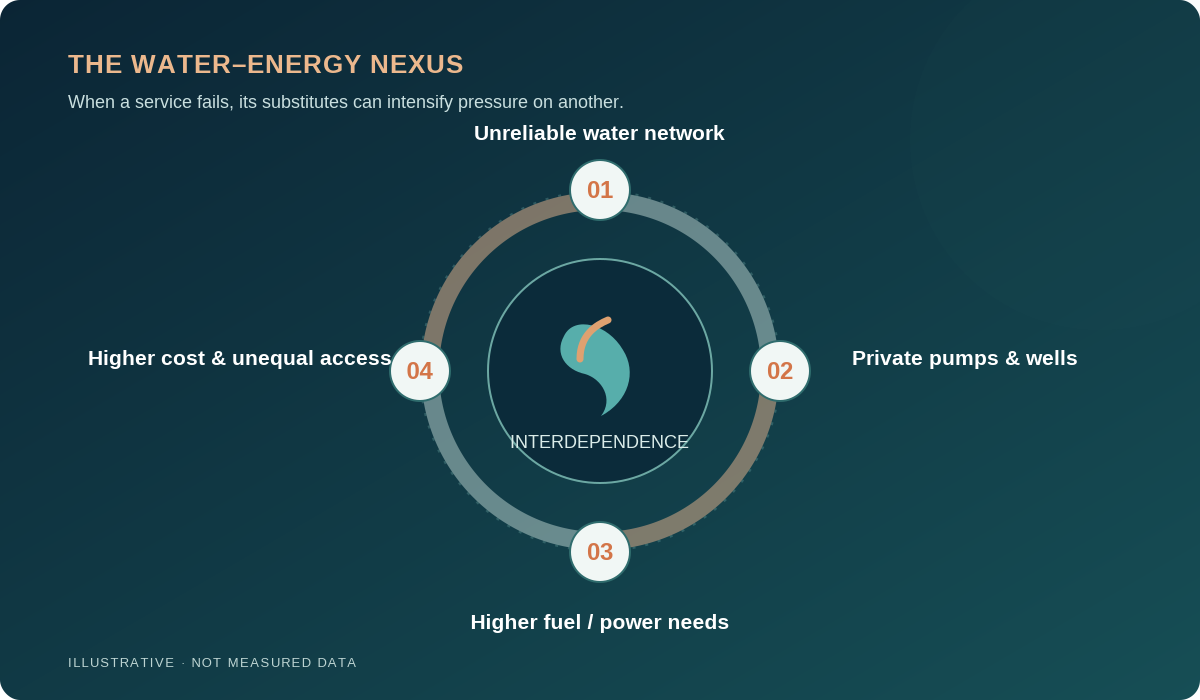
Where dependable network water fails, households and suppliers often turn to deeper wells, electric pumps, diesel generators and water tankers. Every substitute requires energy; its higher cost can make access to water less equal and place fresh pressure on a fragile power system. A shortage of one essential service can thus deepen demand for another, creating a reinforcing cycle of expense, depleted groundwater and weakened public trust.
Supply chains transmit consequences
Food, energy and essential goods travel through a web of transport, payment, permissions and commercial relationships. Conflict can raise costs far beyond the immediate area. Intervention resources may also be captured or redirected by actors able to control access, producing incentives that make resolution more difficult. These are possibilities to test empirically, not automatic conclusions about every assistance programme.
Stability elsewhere is not guaranteed
When crisis-related profits, political leverage or opaque transfers accumulate beyond conflict settings, pressures can travel toward institutions that initially appeared stable. The consequences depend on regulation, incentives and oversight. We study these pathways because peacebuilding and responsible cooperation must consider effects beyond the original geographical focus.
Integration as a question of relationships
Integration is not a slogan for a single corridor or project. It asks where shared resources or functions create a practical need for new arrangements and more credible rules. Sometimes an existing order protects itself through structures that deepen instability. Transformation then means changing relationships rather than only replacing leadership or institutions in name.